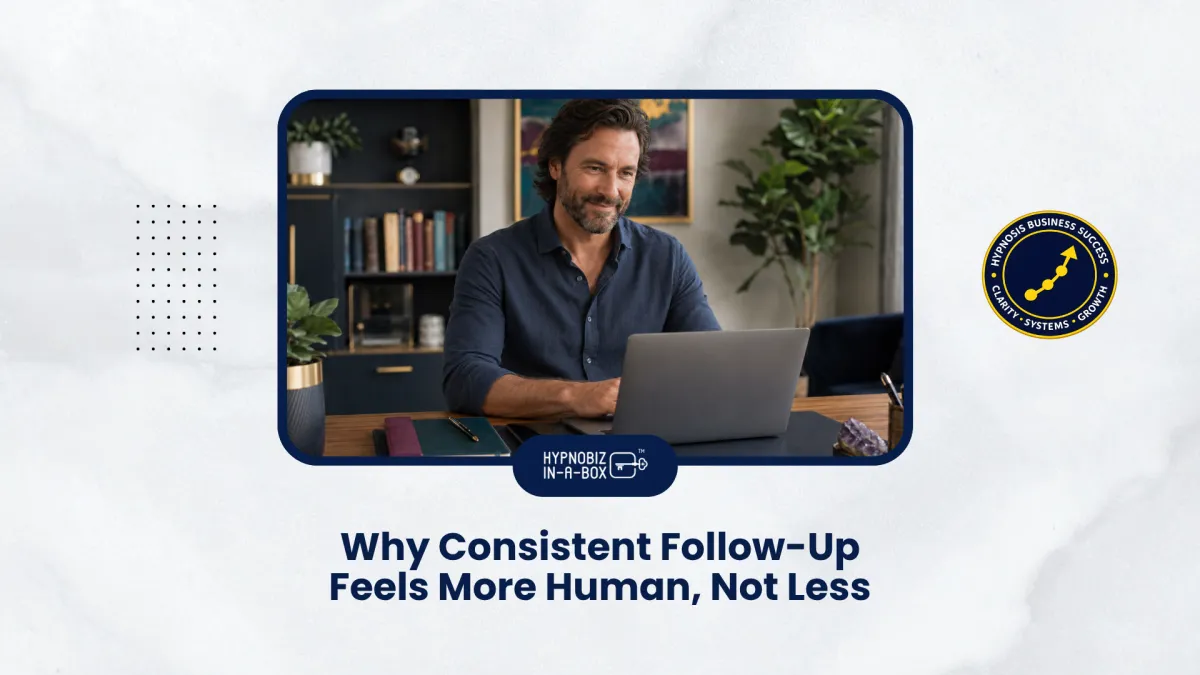
Why Consistent Follow-Up Feels More Human, Not Less
There’s a concern we hear regularly from hypnosis professionals when the conversation turns to automation.
They don’t want their practice to start feeling automated.
That hesitation makes sense. Hypnosis is deeply personal work. Trust matters. Tone matters. The way someone feels when they interact with you matters. Nobody wants to spend years developing a natural way of communicating with clients only to replace it with stiff messages that sound as though they came from a corporate template.
But there’s an important distinction here.
Automation determines when and how a message is delivered. It doesn’t have to determine what that message sounds like.
That difference matters more than it might seem.
Personal and Manual Aren’t the Same Thing
Many hypnosis professionals quietly connect personal service with manual effort.
If you personally remember to send the email, it feels personal. If you personally send the reminder, it feels personal. If you personally follow up after a consultation, it feels personal.
The problem is that running a practice creates a lot of competing demands.
You’re working with clients. You’re preparing for sessions. You’re responding to inquiries. You may be creating content, handling administrative work, updating your calendar, processing payments, or trying to remember the person who asked you to follow up sometime next week.
Eventually, something gets missed.
Not because you don’t care, but because care and memory aren’t the same thing.
A beautifully personal email that never gets sent doesn’t create much connection.
A short, thoughtful message that arrives exactly when someone needs it often does.
That’s where systems can protect the human part of the business rather than replace it.
Consistency Builds Trust Quietly
Think about the experience from the client’s side.
Someone books a consultation and receives a clear confirmation. A reminder arrives before the appointment. After the conversation, they receive the information you said you’d send. A client completes a session and gets the next-step message they were expecting.
None of those interactions need to sound robotic.
They can sound exactly like your practice.
They can use the words you’d naturally use, answer the questions you know people tend to have, and reflect the same tone they experience when they speak with you directly.
The automation simply makes sure the communication happens.
That consistency matters because people rarely experience a business as a collection of isolated tasks. They experience the whole journey.
When each step feels connected, the practice feels professional and attentive.
When communication disappears for several days because you became busy, prospects don’t know that you were helping clients or handling something important. They simply experience silence.
Consistency removes some of that uncertainty.
Your Voice Can Be Built Into the System
The easiest way for automation to sound cold is to use language you’d never actually say.
Generic phrases, overly polished marketing language, fake urgency, or messages copied directly from a template can create distance.
The solution isn’t to abandon automation. It’s to make the communication yours before you automate it.
Write the email the way you’d explain it to a real client.
Use the same language you use during consultations.
Keep the sentences natural.
Answer the questions people really ask.
Remove phrases that feel like marketing language rather than your language.
Once that message sounds right, the system can deliver it repeatedly without changing what made it personal in the first place.
In practical terms, you’re not automating the relationship. You’re systemizing the parts of communication that shouldn’t depend on you remembering every detail at exactly the right moment.
That distinction becomes especially important as a practice grows.
Growth Shouldn’t Require Becoming Less Personal
Manual follow-up can work when there are only a few conversations to manage.
As the number of prospects and clients increases, the same approach becomes harder to maintain. The practitioner either spends more time on administration or communication becomes less consistent.
Neither outcome is particularly attractive.
The better alternative is to decide which parts of the client journey benefit from consistency and build those touchpoints deliberately.
A confirmation doesn’t need to be reinvented every time.
A reminder doesn’t need to be typed from scratch.
A thoughtful post-consultation email can still sound warm even if the system knows when to send it.
That creates room for you to bring your full attention to the places where personal presence matters most, especially your actual conversations and client sessions.
The system handles repetition. You handle the relationship.
The Real Question Isn’t Whether You Automate
The more useful question is whether the experience still feels like your practice.
Does the message sound like you?
Does it arrive at a useful time?
Does it make the next step clear?
Does the person receiving it feel supported rather than processed?
When those things are true, automation doesn’t remove the human connection.
It helps protect it.
For hypnosis professionals who care deeply about the quality of their work, that can be an important shift. The goal isn’t to build a practice where technology replaces personal attention.
The goal is to build a practice where personal attention isn’t constantly competing with repetitive administrative work.
When the right communication keeps happening consistently, clients experience a business that feels organized, thoughtful, and dependable.
And you get to spend more of your energy doing the work that actually requires you.