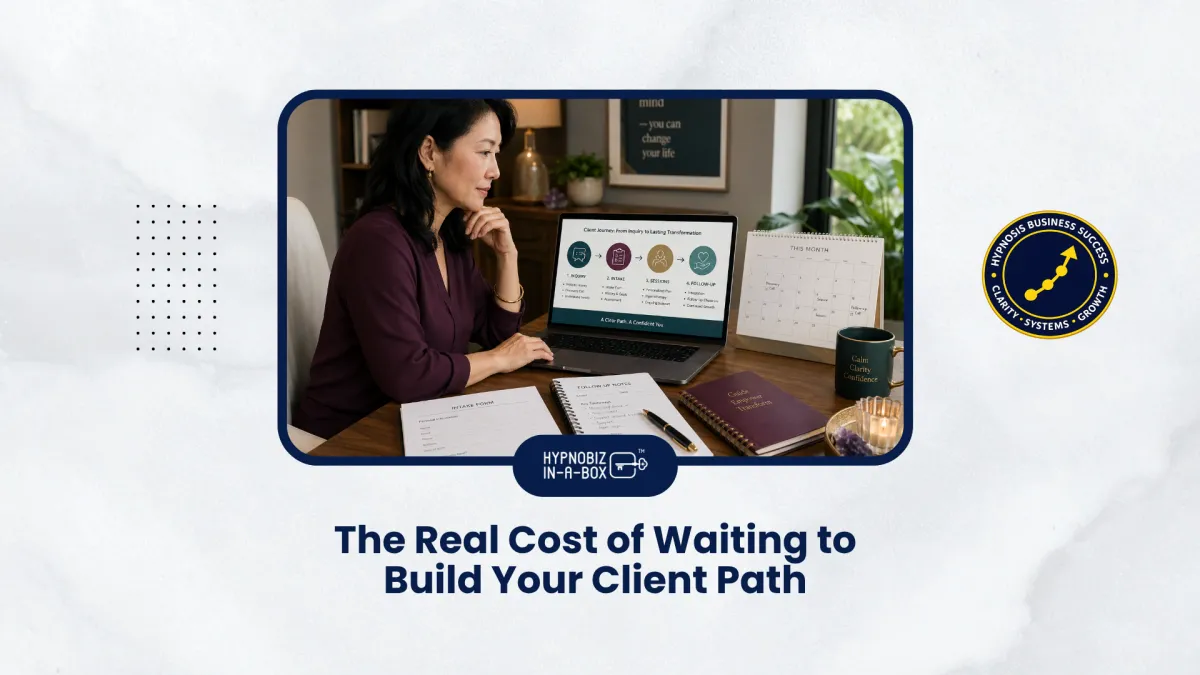
The Real Cost of Waiting to Build Your Client Path
The Real Cost of Waiting to Build Your Client Path
Many hypnosis professionals are careful, thoughtful decision-makers.
They do not want to spend money impulsively. They do not want to invest in tools they will not use. They do not want to add complexity to a business that already feels full.
So when the thought comes up, “I’ll invest when I have more clients,” it can sound practical.
On the surface, that sentence feels responsible. It suggests discipline, patience, and caution. It says, “Let’s not move too quickly.” For a practitioner who is building a business around meaningful client work, that kind of care is understandable.
But there is another side to the pattern.
Sometimes the very thing being postponed is the thing that would help more clients say yes.
That is where the real cost of waiting begins.
For many hypnotists, the issue is not talent. They know how to help people. They care about their clients, they continue learning their craft, and they want their work to be taken seriously. The gap is usually not in the session room. The gap is in the path that surrounds the session room.
A potential client sees a post, visits a page, clicks a link, has a question, tries to book, receives a reminder, and decides whether to follow through. Every one of those moments either builds confidence or creates friction.
When the path is clear, they know what to do next. But when the path is scattered, even a motivated client can drift away.
This is why “free” tools are not always free in practice. A free calendar, a separate form, a manual email, a spreadsheet, a payment link, and a reminder typed by hand may seem manageable at first. Each piece may work on its own. The problem comes from the space between the pieces.
That space is where leads fall through.
Someone fills out a form, but follow-up waits until later. A consult is booked, but the reminder does not go out smoothly. A person is interested, but the message does not clearly show them where to begin. A practitioner intends to follow up, but the day fills with client work, family responsibilities, training, and admin.
Nothing dramatic happens and that is part of the problem. The cost of waiting often looks ordinary.
It looks like a quiet calendar. It looks like inconsistent inquiries. It looks like wondering whether the marketing is working. It looks like a practitioner spending valuable energy trying to remember what happens next instead of trusting the system to carry the next step.
Over time, that unpredictability becomes expensive.
Not only financially, but mentally.
A scattered client path makes every inquiry feel more fragile. Each potential client requires attention, tracking, remembering, checking, and manual effort. The hypnotist ends up holding too much in their own mind.
That is not a sustainable business model.
It is also not the most supportive client experience.
People seeking hypnosis are often already dealing with a problem they want help with. They may be anxious, discouraged, overwhelmed, or unsure. A clear path gives them a sense of confidence before they ever enter a session. It tells them, “This practice is organized. This practitioner knows how to guide people. I know what happens next.”
That matters.
Professional structure does not replace personal connection. It protects it.
When booking, reminders, follow-up, and communication are organized, the practitioner can be more present. They are not trying to remember whether the confirmation email went out. They are not scrambling to find the intake form. They are not manually rebuilding the same process over and over.
The business begins to support the work.
This is the shift many hypnosis professionals miss when they think about affordability.
The question is not only, “Can I afford to invest?”
A better question is, “What is my current setup already costing me?”
If the current setup costs time every week, that matters. If it creates missed opportunities, that matters. If it makes the business feel unprofessional or inconsistent, that matters too.
The cost may not show up as a single invoice, but it still shows up.
It shows up in delayed follow-up, lower confidence, and the feeling that every client has to be chased manually.
A clear client path changes that experience.
It does not mean the practitioner has to become a tech expert. It does not mean the business becomes cold, automated, or impersonal. It means the basic path is built properly so clients can move from interest to action with less friction.
They can find the practice, understand the offer, book a call, and be followed up with thoughtfully. This way they feel guided before the first session begins.
That is not extra, it’s part of the business.
For a hypnosis professional who wants steady clients and reliable income, waiting is not always neutral. Sometimes waiting simply preserves the same scattered pattern that has already been creating inconsistent results.
A more responsible decision may be to build the path before the calendar is full.
Because a full calendar does not usually appear from nowhere. It is supported by clarity, structure, and follow-through.
When the path is working, the business becomes easier to trust.
Clients feel it.
The practitioner feels it.
And the calendar has a much better chance of reflecting the quality of the work being offered.